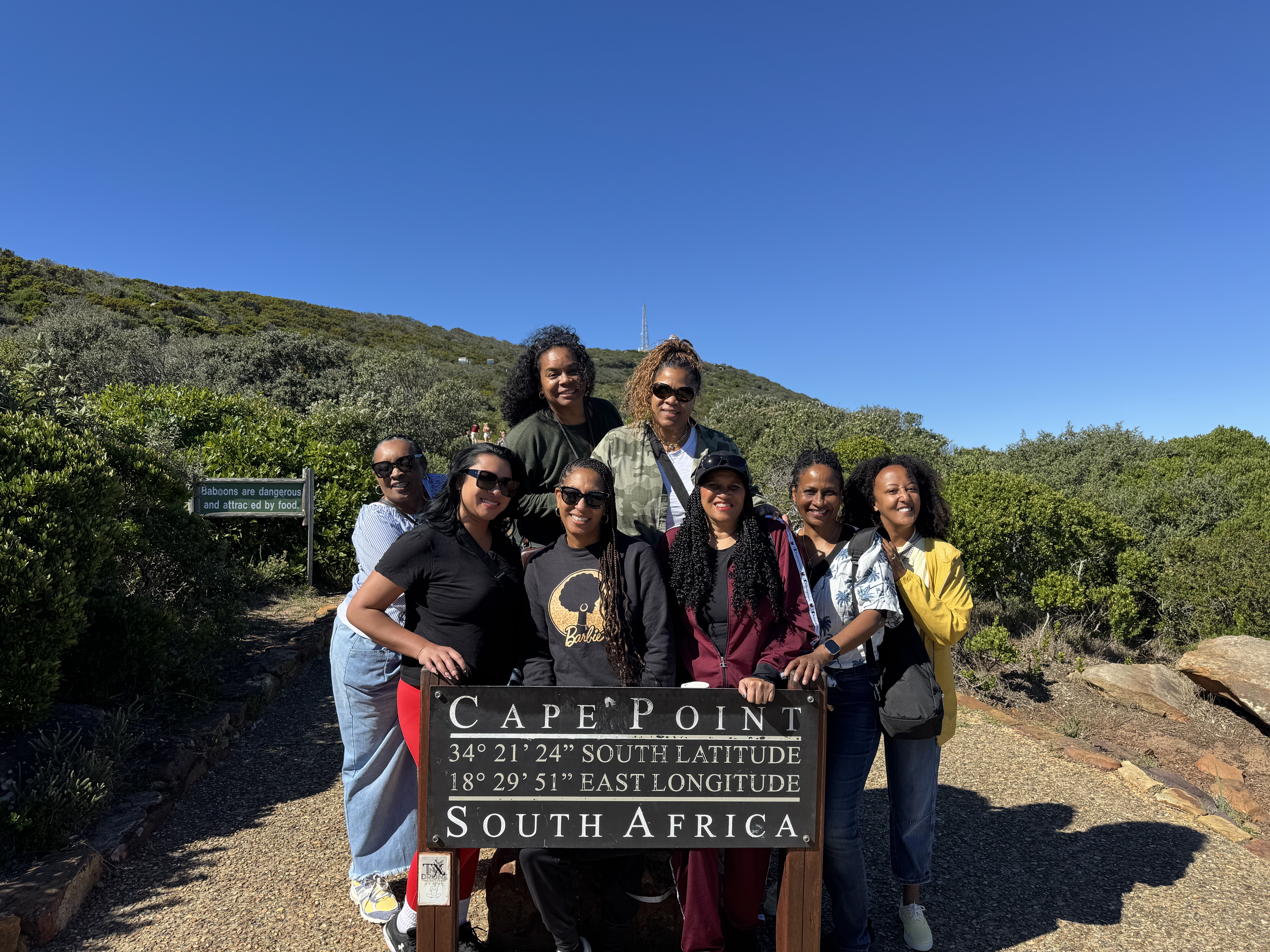
Let’s start here, because I know my mom friends… you saw pictures and videos and you were wondering.
Yes, I flew business class to South Africa with a layover in London to eat fish & chips. Yes, I rested. Yes, I stretched my legs like a woman who pays taxes and has earned softness in her life. And yes I took my friend along for the ride and we had a fabulous time. When we book the next group trip get ready!
Now that we’ve established that I traveled appropriately on the way there, let’s talk about what this trip actually was.
Because South Africa is not a place you simply visit. It is a place you encounter.
We landed in Johannesburg and checked into Sandton Sun & Towers, which was exactly what you want after a long flight. Clean, elevated, structured. A soft landing into a country that carries a very complex history.
That first night, we went to Marble Restaurant, and let me just say the food was beautiful. The ambiance was right. The kind of place where you sit up straight and order something you can’t pronounce. But it didn’t take long to notice something subtle but important. The service was… different. Not bad. Just different enough to make you pause and start asking questions you weren’t expecting to ask on night one.
And that is how South Africa introduces itself to you. Gently at first. Then all at once.
The next day, we went to Soweto.
Now let me shift my tone, because this part matters.
Soweto is not just a place. It is a living archive of resistance. It is where the 1976 student uprising took place, where Black South African children protested the apartheid government’s decision to enforce Afrikaans as the language of instruction. These were children. Organized. Intentional. Courageous. And many of them paid with their lives.
We visited the Hector Pieterson Museum, which honors a 12-year-old boy who became the face of that uprising. And let me tell you something, standing there, looking at that history, realizing how recent it is, it does something to you. This is not distant history. This is not something tucked away in a textbook. This is modern. This is living memory.
We also visited Nelson Mandela’s home. And what struck me was not just his legacy, but the reality that his life and imprisonment are not ancient history either. He was released in 1990. Some of us were already alive.
That day was heavy. There is no other way to describe it. We left asking ourselves why. Why so much violence. Why so much division. Why so recent. And more importantly, what does it mean that so much of that structure still echoes in the present?
Because it does.
Then we transitioned to Cape Town, also known as the Mother City, which felt fitting in more ways than one.
This was also my best friends 50th birthday, so now we are layering celebration on top of reflection, which is honestly how life works. Joy and heaviness rarely travel separately.
Cape Town is visually stunning. Table Mountain sits like it knows it’s important. The coastline is breathtaking. The neighborhoods are vibrant, colorful, and full of life. But even in the beauty, there are contrasts that you cannot ignore.
You will see wealth.
You will see poverty.
And you will see them exist side by side in a way that forces you to confront what inequality actually looks like when it is not hidden.
We visited District Six, which was once a thriving, multicultural community that was forcibly removed during apartheid. Over 60,000 people displaced. Homes destroyed. Culture erased. And again, not hundreds of years ago. Within a generation.
History in South Africa is not buried. It is visible.
And then, because life insists on balance, we went on safari.
Now let me tell you, this was spectacular. Open land, expansive skies, animals moving in ways that feel both majestic and completely unbothered by your presence. We saw almost all of the Big Five, and for a moment, you remember that there is a version of the world that exists outside of human systems. Untouched. Unstructured. Just… being.
It was a necessary reset.
We also traveled along the Cape Peninsula, saw the penguins, took a champagne cruise, and ended in the wine country of Stellenbosch and Franschhoek, which, let’s be clear, was an absolutely appropriate way to close out a trip of this magnitude. The vineyards were stunning. The wine was excellent. And the energy shifted back into something softer, more reflective, more grounded.
But let’s talk about the part that requires care.
Because as Black American women, we entered a very specific social dynamic.
In South Africa, there is a racial classification system that still lingers from apartheid. “Black,” “White,” and “Coloured” are not casual descriptors. They are historical categories with deep social implications. And as Americans, we quickly realized that we were being read differently depending on context.
We were asked if we were sure we were with the right tour guide.
We noticed differences in service.
We learned, quietly, that there are assumptions about Black Americans not tipping, about who we are, how we move, and what we represent.
And again, you are forced to sit with it.
Identity is not universal. Race is not experienced the same way everywhere. And what it means to be Black in America does not translate cleanly across borders.
That realization alone is worth the trip.
South Africa is beautiful. There is no question.
But it is also layered. Complex. Still healing. Still evolving.
It holds its history in plain sight while simultaneously building something new.
And if I’m being honest, it made me think deeply about what it will look like in twenty years. What will shift. What will remain. What will finally feel resolved.
Because right now, it feels like a country in transition.
So yes, I traveled well on my way there. Yes, I enjoyed myself. Yes, there were moments of luxury and laughter and matching pajamas watching movies like we had no responsibilities waiting for us at home.
But this was not just a vacation.
It was an education.
And the kind you don’t get to opt out of once you’ve experienced it.
And on the way back, I flew economy.
Now let me be honest, because transparency is part of my brand. Coming home always feels a little… disappointing. The trip is over, the magic is fading, and you’re sitting there trying to emotionally process everything while someone’s elbow is entirely too close to your personal space. So yes, sitting in economy, quietly mourning the end of the trip, felt appropriate. I did not need the free champagne. I was already in my feelings.
But somewhere between the discomfort, the exhaustion, and the silence that comes when everything slows down, I realized something important. The trip itself was never the final product. The real question was always going to be, what story am I bringing home?
What am I going to tell my children about what I saw, what I learned, and what I now understand differently? How do I translate history, complexity, beauty, and tension into something they can hold onto? And more importantly, how does it show up in the way I choose to live, to lead, and to build from here?
Because if the experience doesn’t change how you move, then it was just a vacation.
And this… was never just that.
Always Have, Always Will ~ Kalie


Leave a Reply