Why Some Parents Lowkey Don’t Like Bluey (Even Though We Absolutely Do)
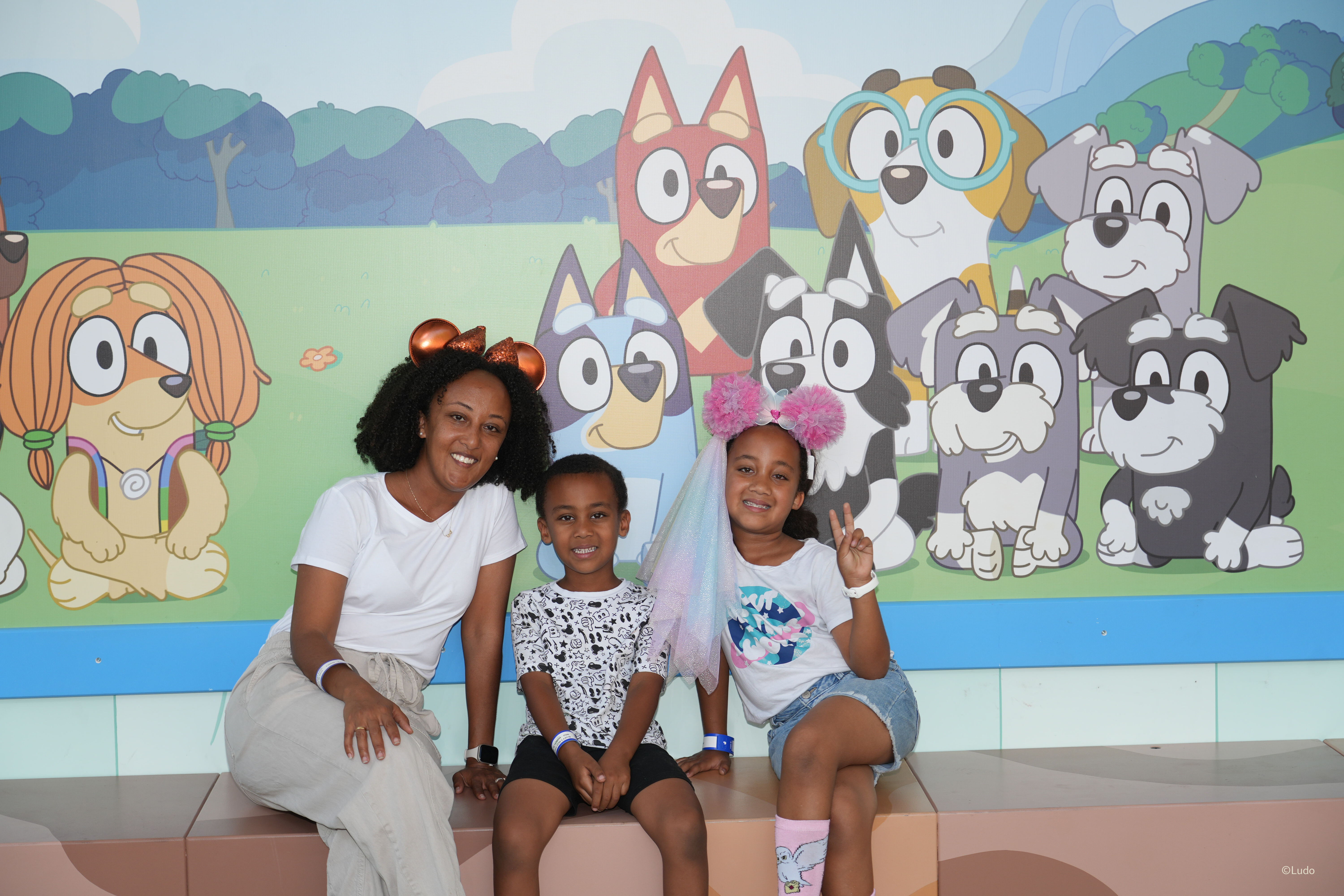
A few weeks ago, I took my kids to see the “Bluey’s Best Day Ever” show preview at Disneyland on a weekday, no less. I told them it was for my birthday, which in my opinion is a completely valid reason to skip school when you are a mother in Southern California trying to create childhood memories and also survive. If you understand that logic, we are aligned. If you don’t, I would love to know what coping mechanisms you are using because clearly I have more to learn.
We spent the morning in Toontown, and at some point I realized my children had absolutely no interest in rides. None. They wanted to run, explore, and fully embody the concept of “free-range childhood” while I sat down, adjusted my expectations to zero, and people-watched like a woman who has accepted her fate. Honestly, once I surrendered to that reality, I had a wonderful time. I even took pictures with characters… alone… because I could not find my kids. That is a story for another day.
Now, back to Bluey.
The show itself! Adorable. Thoughtful. Emotionally layered in a way that feels almost disrespectful for a children’s cartoon because why am I reflecting on my parenting at 1:30pm with a juice box in my hand?
And yet, despite how much I genuinely enjoy it, we have a very clear policy in our house. Bluey is on a limited-access basis. Special occasions. Long flights. Moments of strategic necessity.
Why?
Because it is, quite frankly, setting the bar in a way that feels… aspirational to the point of inconvenience.
Let’s just say the quiet part out loud. Why is this cartoon making fully grown, responsible, tax-paying adults feel like we are underperforming?
Take Bandit Heeler, for example, I don’t like him. This man is operating at a level of parental excellence that feels both admirable and slightly unrealistic. He has endless patience, Olympic-level stamina, and a willingness to engage in imaginative play at any given moment. There is no visible inbox, no background stress, no indication that he has ever had to cook dinner while answering a message and reminding a child repeatedly to put on their shoes. Does he even have a job?
He is present in a way that feels… luxurious.
Then we have Chilli Heeler. Calm. Grounded. Emotionally intelligent, I like her. She holds structure and softness in perfect balance, like someone who has never once been overstimulated in her life. Watching her feels like watching the ideal version of motherhood. And while that can be inspiring, it can also feel like a quiet expectation that you should be all of those things at once, even on the days when you are tired, touched out, and would very much like five uninterrupted minutes of silence.
What makes this even more interesting is that most parents don’t actually dislike Bluey. In fact, we appreciate it. Deeply. The storytelling is intentional. The lessons are meaningful. The emotional intelligence is far beyond what most of us grew up watching.
But that is exactly the point.
Bluey doesn’t just entertain children. It presents an ideal. And when an ideal is presented consistently, it can begin to feel like a standard, even when no one has explicitly said that it is.
Then there is the emotional layer, which I find particularly fascinating. Why is a seven-minute animated episode prompting adults to reevaluate their level of presence? Episodes like “Baby Race” are not just for children. They are reflections. They gently, but very clearly, hold up a mirror and ask you to consider how you are showing up in the small, ordinary moments of your child’s life.
It is beautiful. It is also, at times, mildly confronting.
And of course, we cannot ignore the very practical impact. This show has children requesting an unreasonable number of interactive experiences throughout the day. Suddenly you are being asked to become a horse, a doctor, a taxi driver, and a fully immersive character in a game that has no clear end time. All while you have very real responsibilities and, unlike Bandit, a schedule.
Respectfully, Bandit does not have a calendar.
But underneath all of the humor, there is something worth acknowledging. The discomfort some parents feel is not really about the show itself. It is about what the show represents. A version of parenting that is slow, present, imaginative, and deeply connected.
And in a world where most parents are balancing work, home, identity, and the general weight of modern life, that version can feel both inspiring and slightly out of reach.
So if you have ever found yourself slightly irritated while watching Bluey, it does not mean you do not appreciate it. It simply means you are living in reality. You are parenting in real time, not within a perfectly written seven-minute storyline.
And that matters.
Because the goal was never to become Bandit. The goal is to be yourself, showing up as best as you can, with just a little more awareness than you had yesterday.
And honestly, that is more than enough.
Now, with that said, if you happen to be at Disneyland and the line for the show is short, I highly recommend you go. Sit down, enjoy it, sing a little, maybe reflect a little, and then gently remind yourself that you are doing just fine.
Also, if you are going to watch it at home, I recommend Season 3. Slightly more grounded. Slightly less pressure.
Because if this is how our children are experiencing parenting through television… I can only imagine this is how our parents felt watching The Cosby Show and quietly wondering how everyone in that house was so calm.
Some things… truly come full circle.
Aways Have, Always Will ~ Kalie


Leave a Reply